
Medically reviewed by Mark A. Schrumpf, M.D. | Reviewed July 2026
I have patients tell me all the time that they’re not ready yet for shoulder replacement, even after years of pain. I understand the hesitation completely. But one question we often discuss in these cases is, “What happens if you wait too long for shoulder replacement?” The truth is that in many cases, waiting may have a cost. In this post, I will walk through how I think about timing with my own patients.
Key Takeaways
- Shoulder replacement is usually an elective procedure, so there is rarely a single moment when surgery becomes mandatory.
- Waiting too long for shoulder replacement can sometimes lead to progressive bone loss, muscle atrophy, and stiffness that make the eventual surgery more complex.
- Chronic shoulder pain and reduced use of the arm can affect sleep, mood, and daily function well before someone decides to have surgery.
- The right time for surgery is different for every patient. It is a decision made collaboratively, not on a fixed calendar.
Why Patients Wait
There are a lot of reasonable reasons people put off shoulder replacement. Some are hoping physical therapy will keep working a little longer. Some are waiting for a quieter season of life, a retirement date, or a break between family obligations. Others are simply nervous about surgery, which is a normal response and one I take seriously in every consultation. None of these reasons are wrong. My job is not to talk anyone into surgery before they are ready. It is to make sure the decision to wait is an informed one.
What Happens Inside the Shoulder as Arthritis Progresses
Shoulder arthritis and rotator cuff disease tend to move in one direction without treatment. As the cartilage lining the joint continues to wear, the bones can develop irregular surfaces and bone spurs, and the joint space itself may narrow further. In some patients, the glenoid, the socket portion of the joint, wears unevenly rather than uniformly, which can make later reconstruction more technically demanding.
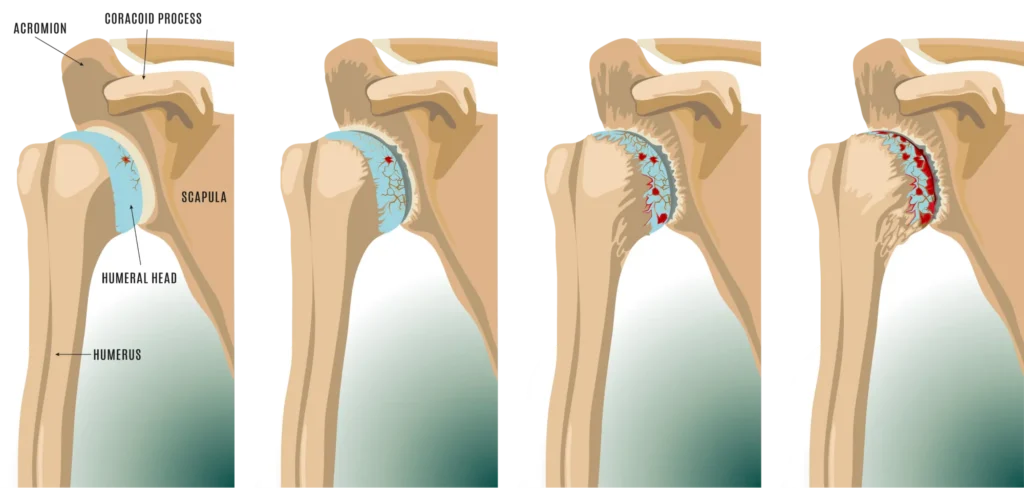
In patients with an already compromised rotator cuff, waiting can allow further tendon degeneration. In the most advanced cases, this can progress toward a condition called cuff tear arthropathy, where the joint and the rotator cuff have both broken down to the point that a reverse shoulder replacement becomes the more appropriate option rather than a traditional, anatomic replacement. That shift is not a failure on the patient’s part. It is simply what can happen when severe joint damage and rotator cuff loss occur together over time.
The Physical Cost of Waiting Too Long for Shoulder Replacement
A few specific changes tend to show up in patients who have waited a long time:
- Bone loss around the glenoid, which can limit implant options or require bone grafting at the time of surgery.
- Muscle atrophy in the rotator cuff or deltoid, since a painful shoulder is often protected and underused for years.
- Progressive stiffness, which can persist even after a successful replacement.
- Compensatory strain on the neck, upper back, or the opposite shoulder from favoring the painful side.
In my experience, the shoulders that have been neglected the longest are usually the ones that take the most work to reconstruct. That does not mean surgery becomes impossible. It means the operation and the recovery afterward tend to be more demanding than they may have been a few years earlier.
The Everyday Cost, Not Just the Surgical One
It is worth separating two different kinds of cost when we talk about waiting too long for shoulder replacement. One is surgical, the bone loss and muscle atrophy described above. The other is simply lived experience, and I think it gets undervalued. Chronic shoulder pain tends to disrupt sleep long before it becomes unbearable during the day, and poor sleep has a way of affecting mood, energy, and patience with everyday life.
Patients frequently adapt without realizing how much they have given up. They stop reaching for the top shelf, stop playing with grandchildren the way they used to, or quietly give up a sport or hobby rather than mention it as a loss. When I ask directly during a consultation, most patients can list several activities they have already scaled back or stopped, sometimes years before ever bringing up surgery as an option. None of that shows up on an X-ray, but it is real, and it is part of the timing conversation I have with every patient.
What I See in My Patients
Some of the more complex reconstructions I perform are on patients who waited five or more years past when I would have first recommended surgery. By the time they come in, the glenoid bone has often worn unevenly, and the rotator cuff or deltoid has weakened from years of guarding the shoulder. None of that makes surgery impossible. It does change the conversation. I still see this regularly in patients across San Francisco and Marin who simply put the decision off longer than their shoulder could comfortably tolerate.
My Approach to Timing
I do not push patients into surgery before they are ready, and I never present shoulder replacement as urgent unless it genuinely is. What I do insist on is an honest conversation about trajectory. If imaging shows the joint deteriorating and function declining year over year, I say so plainly, because choosing to wait is not a neutral decision. It carries its own consequences, and patients deserve to understand what those are before they decide.
Whether the eventual procedure is a total shoulder replacement or a reverse shoulder replacement, I would rather plan that surgery on my terms and the patient’s terms than react to a shoulder that has been left untreated well past the point I would have recommended stepping in.
When Waiting Becomes Riskier
A few situations tend to raise the stakes of delay more than others. Patients with a large, irreparable rotator cuff tear combined with arthritis are at real risk of progressing to cuff tear arthropathy, which narrows the surgical options down the road. Older patients with certain complex shoulder fractures and poor bone quality can also find that delay complicates reconstruction, since the bone itself becomes less forgiving to work with over time. In these situations, I tend to be more direct about the value of not waiting much longer.
How Delay Can Change the Surgery Itself
Beyond bone loss and muscle atrophy, longer-standing arthritis can also mean more scar tissue and a stiffer joint capsule by the time surgery happens. That stiffness may add time in the operating room, since additional soft tissue release is often needed just to restore a reasonable range of motion before the implant is even placed.
None of this means a delayed surgery is doomed to a worse outcome. Most patients still do well. It does mean the operation tends to be less routine, the recovery can take a bit longer to settle, and the range of implant options on the table may be narrower than they would have been with earlier intervention. I would rather a patient know that trade-off in advance than discover it only once they are already on the operating table.
Summary
If your shoulder pain has been persistent and impacting your life for the past year or two, the next step doesn’t have to be deciding about surgery today. It is to get updated imaging and a clear picture of where your joint actually stands right now, so that waiting becomes an informed choice rather than a default one. Schedule an evaluation to get that picture.
Frequently Asked Questions
Is shoulder replacement ever an emergency?
Most shoulder replacement surgery is elective, meaning it is planned rather than urgent. Certain complex fractures are the exception, where surgery may need to happen sooner to achieve the best outcome. Your surgeon can tell you which category your situation falls into.
If I have already waited several years, is it too late for me?
Most patients who have waited a long time are still good candidates for surgery, though the operation and recovery may be more involved than they would have been earlier. The best way to know your own situation is a current evaluation with updated imaging and a consultation.
How do I know when it is the right time to consider shoulder replacement?
The right time for shoulder replacement is usually when pain and loss of function begin interfering with the activities that matter most to you, and non-surgical treatments are no longer providing enough relief. This decision is not based on an X-ray alone. I consider your symptoms, your goals, your activity level, your imaging, and how much the shoulder is limiting your daily life.