Medically reviewed by Mark A. Schrumpf, MD
Patients regularly ask me what they can do at home to help a new shoulder along. My answer is that exercise after shoulder replacement matters a great deal, but the right exercise depends on timing. A movement that helps at three months could set you back at three weeks. That’s why I think of rehabilitation less as a random list of moves and more as a progressive sequence.
Key Takeaways
- Exercise after shoulder replacement generally moves through three stages: protected passive motion, active motion, and then strengthening.
- Early exercises protect the healing joint, so pushing too hard too soon may slow your progress.
- Your exercise plan may look different depending on whether you had a total or reverse shoulder replacement.
Why Exercise Matters After Shoulder Replacement
A new implant may help relieve the pain of a worn-out joint, but it cannot move the arm by itself. The muscles, tendons, and soft tissues around the shoulder have to heal and then relearn how to work with the new joint. Exercise is a big part of how that happens.
Early, controlled movement can help prevent stiffness and scar tissue. Later, strengthening helps the shoulder become stable and dependable for everyday tasks. Skipping either stage tends to make recovery longer and harder than it needs to be.
Getting a Head Start Before Surgery
Exercise doesn’t always have to wait until after the operation. Before a reverse shoulder replacement in particular, some patients benefit from a pre-operative physical therapy program that focuses on strengthening the deltoid and keeping the elbow, wrist, and hand moving well. A stronger deltoid going in may be a practical advantage, since that muscle does much of the lifting afterward. Learning a few of the early exercises ahead of time also makes the first weeks at home feel less unfamiliar.
Stage 1: Gentle, Passive Motion
Timelines may vary between patients, but recovery follows a gradual progression. In the first stage, protection comes first. The arm rests in a sling for roughly the first four to six weeks, including while you sleep.
Physical therapy frequently begins within the first week. These early sessions focus on passive range of motion, which means a therapist or your other arm moves the operated arm for you. Your shoulder muscles stay relaxed. The goal is to keep the joint from stiffening while the soft tissues heal. During this stage, avoid lifting, pushing, or pulling anything with the operated arm.
Stage 2: Active Motion
Around the six-week mark, as you transition out of the sling, the focus shifts to active range of motion. Now you begin moving the arm with your own muscles. The exercises are still gentle and controlled, and your therapist will guide how far to go.
This is when light, everyday tasks like eating, dressing, and grooming tend to get easier. Toward the end of this stage, your therapist may add isometric exercises, which strengthen a muscle by tightening it without moving the joint. Expect good days and stiffer days during this stretch, and know that the unevenness is normal. I ask patients not to push through sharp pain here. Discomfort from stretching is one thing, but sharp pain is a signal to stop.
Stage 3: Building Strength
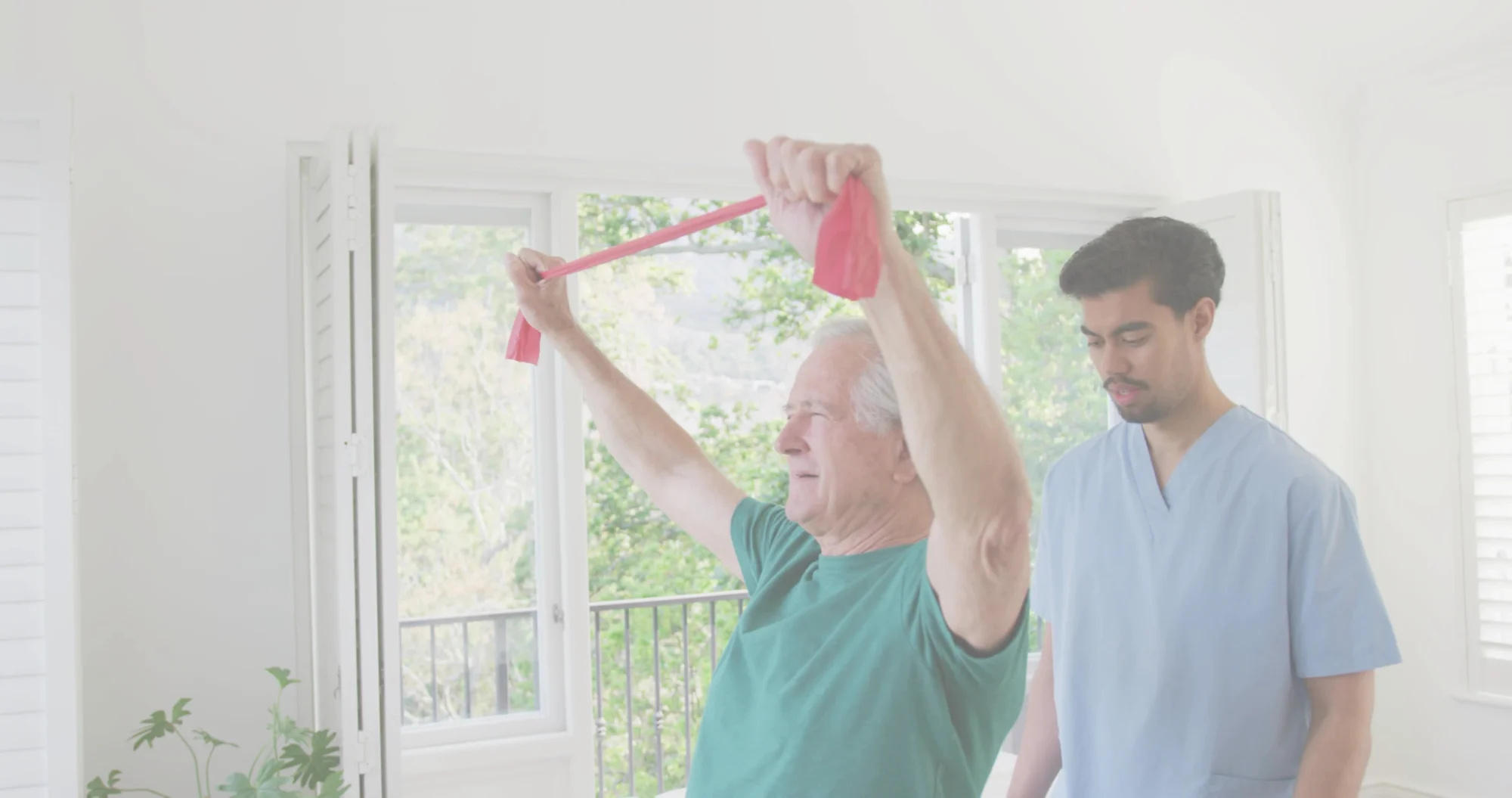
Around three months, many patients have regained a functional range of motion, and strengthening takes center stage. Your therapist may add resistance bands, light weights, and functional movements. The focus is on the muscles around the shoulder and the shoulder blade, which help stabilize the new joint.
Lifting limits may loosen gradually across recovery, though specific plans vary between patients:
- The first six weeks: Patients are typically advised to lift nothing heavier than a cup of coffee.
- Around three months: Light lifting, such as a gallon of milk, may come back into the picture.
- Six months and beyond: Heavier lifting, over 10 to 15 pounds, often requires six months or more of dedicated strengthening.
Eventually, physical therapy may transition to an independent home exercise program. Low-impact activities like swimming or golf might be possible around the six-month mark, depending on your progress.
How Exercises Differ for Total vs. Reverse Replacement
The stages look similar for both procedures, but the muscles your therapist focuses on can differ.
A total shoulder replacement is usually performed when the rotator cuff is healthy. Because that engine of the shoulder is intact, early rehab may progress slightly faster in some cases.
A reverse shoulder replacement relies on the deltoid, rather than the rotator cuff, to lift the arm. Teaching the deltoid to do that job is the key functional goal of rehab after a reverse. This can take patience, especially for patients who spent years compensating for a painful shoulder.
Movements to Avoid Early On
In the protective phase, the biggest risk is doing too much. Lifting, pushing, and pulling with the operated arm can strain tissues that are still healing. Reaching for a high shelf, carrying groceries, or pushing yourself up from a chair with the operated arm are common ways patients overdo it. Your therapist might also limit certain positions for a time, depending on your procedure.
Over the long term, I generally discourage high-impact activities, contact sports, and repetitive heavy lifting. These put extra stress on the implant and may shorten how long it lasts.
What I See in My Patients
The patients who do well with exercise after shoulder replacement tend to treat their home program as part of the daily routine, not an optional extra. They show up for therapy, do the work between visits, and let me know when something feels off.
The ones who struggle frequently feel good early and start using the arm before the tissues are ready. Less pain does not always mean the shoulder has finished healing, and that gap can lead to setbacks.
My Approach to Rehab After Shoulder Replacement
I trained at the Hospital for Special Surgery in New York and completed my shoulder and elbow fellowship at the San Francisco Shoulder, Elbow and Hand Clinic. Today, I see patients at my offices in San Francisco and San Rafael and serve on the medical staff at California Pacific Medical Center. Consistency with physical therapy is one of the factors I discuss before surgery, because it plays such a large part in how the shoulder recovers.
I typically see patients for a first follow-up visit about 10 to 14 days after surgery. From there, I monitor progress alongside your physical therapist and adjust guidance as you go, including when it may be safe to drive and return to other activities.
Summary
Exercise after shoulder replacement follows a deliberate order: protected passive motion first, active motion next, and strengthening last. Each stage builds on the one before it, and the timing may shift based on your procedure and how your shoulder heals. Following your plan closely, without rushing ahead, can make a meaningful difference in your recovery.
If you’re preparing for surgery or working through recovery, schedule an evaluation and bring your current exercise sheet or physical therapy notes so we can review them together.
Frequently Asked Questions
When can I start exercising after shoulder replacement?
Gentle passive motion often begins within the first week. Active exercises start around six weeks, once you transition out of the sling, and strengthening follows around three months. Timing varies based on your procedure and how you heal.
How often should I do my exercises?
Early on, sessions are commonly short and repeated a few times a day. Your therapist will give you a specific schedule, and it’s best to follow it rather than adding extra sessions on your own.
Is it normal for exercises to hurt?
Mild soreness or a stretching sensation is expected, especially early in recovery. Sharp pain is different. If an exercise causes sharp pain, stop and let your therapist or my office know.
When can I lift weights again?
Light lifting, such as a gallon of milk, may come back around three months. Heavier lifting usually takes six months or more of dedicated strengthening, and I might restrict certain activities long term to protect the implant.